
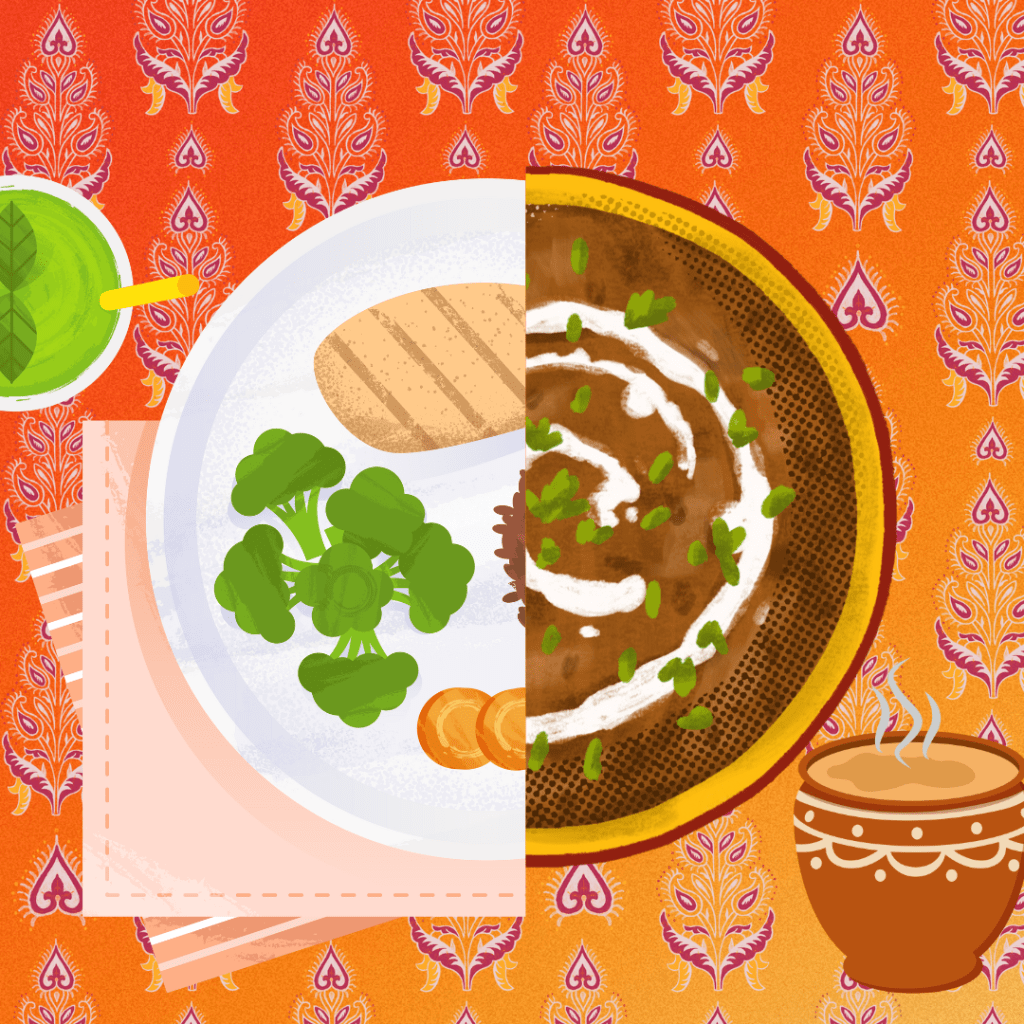
Food is comfort, healing, and sustaining. Our cultural foods connect us to our ancestors. The smell of our spices reminds us of the warmth of home. With each flavourful bite, we relive the moments spent with those closest to us. But what happens when life gets in the way of this enjoyment? When your body is no longer able to tolerate the foods that once brought you comfort.
This is a question I mauled over the last 8 years, since my Ulcerative Colitis (UC) diagnosis. I remember when I first was diagnosed, I struggled to trade in my Indian spices for bland food. And on the days my willpower grew weak I would overindulge in the spicy foods that comforted me. To justify each lapse, I would say if I was gonna be in pain might as well enjoy what I was eating. After every episode, I would be filled with a pang of guilt and would return to completely simple and bland foods again. As a 17-year-old this was the only way I knew how to cope. No matter what I ate, I was always dealing with abdominal cramps, running to the bathroom, and always feeling fatigued. Unfortunately, no amount of medication helped my symptoms. Each change of medication felt like it was my fault.
Gradually I started to see my body change and my self-consciousness increase. Long-term use of steroids for inflammation, caused my cheeks to puff up. A phenomenon that is known as moonface. Another one of my medications to help my body not attack my colon, made me super nauseous after each dose. Thus affecting my mental health around eating. Eating went from something that I enjoyed to something that I had to do to survive. A rhetoric that was reinforced by many of the medical professionals who were a part of my care at that time. Rather than meeting me where I was at that time, I was expected to do a complete 180 when it came to my eating habits. I was told to focus on eating a Mediterranean diet and that my symptoms would improve. Surely a medical professional couldn’t be steering down a path that wasn’t correct.
So when symptoms didn’t improve, or when I would “cheat” on my diet, I felt as if my symptoms were all my fault. It wouldn’t be until I joined a support group called IBDesis that would see this wasn’t the case. This is a support group for South Asians living with IBD( Ulcerative Colitis is one of the forms of IBD). Here would be the first time I would see folks struggling with the same issues as me. I would soon learn, I wasn’t the only one struggling to digest raw veggies. This is not to say that everyone with IBD struggles with raw veggies, but rather that diet for disease management varies from person to person. Unfortunately, the dietitians and nutritionists I have worked with up until now had a very Western view of what a healthy diet should be and had little knowledge of how to care for someone with a condition such as IBD. It was in this group that I learned how to advocate for myself when the advice my dietitian was giving didn’t make sense. Through discussions with members of the community, I was able to learn valuable tools to own my UC. The most important one is a food diary.
Essentially how a food diary works is, that I would track the foods I ate and how I would feel afterward. At the start of my journey, it was helpful to write out the data, whereas now it’s more second nature. It was through this process that I was able to re-introduce my cultural food and the other foods I loved eating. With each preparation, I would tweak things to figure out how to get the flavor profile I enjoyed, without exacerbating my condition. For example, I learned I could use ginger and garlic to increase the spicy profile when my condition was active and I couldn’t tolerate chilis as much.
The next thing I started to implement was using an instant pot. As someone who struggles with fatigue, some days the best I can do is put some frozen veggies, veggie broth, and some spices into the instant pot and pressure cook it. And even this felt weird at first. At 26 I still struggle to cook for myself. Ironically enough I was still holding myself to a standard that was never made for my body type or my UC. However as I saw my fatigue improve, cramps lessen and mood lift from the food I was making due to my instant pot, I saw how useless it was to try to achieve something that didn’t work for me. If cooking in an instant pot works better than a stovetop, then that is what works for me. Why pick the harder choice? Especially when the judgment is coming from within.
I even learned that I can have some “normal” foods as well, along as I prep my body ahead of time. For me that means drinking some electrolytes to help my body hydrated. And to have that meal earlier in the day so I can take digestion medications if needed. Or cook a creamy soup like butternut squash soup so my stomach can rest in the evening.
If I can leave you with three things its would be the following:
- When your healthcare feels like it does not see you as a whole don’t be afraid to speak and/or get a second opinion.
- Take the time to process your emotions and release any internal judgment you have.
- Meet yourself where you are at, and not where you are expected to be
As always remember to embrace your Shakti,
Max Chaudhary
 Embrace Your Shakti
Leave a comment