The simple act of Migration can hold so much Trauma, when left unaddressed this trauma becomes generational Trauma. Something that seems to be an integral part of many diasporas, can also be the very thing that hinders the future generations from reaching their full potential. Although for this entry I will be focusing on the South Asian Diaspora, I wholeheartedly recognize many other diasporas have been through displacement, and struggle with the issue of self and staying rooted to where we come from.
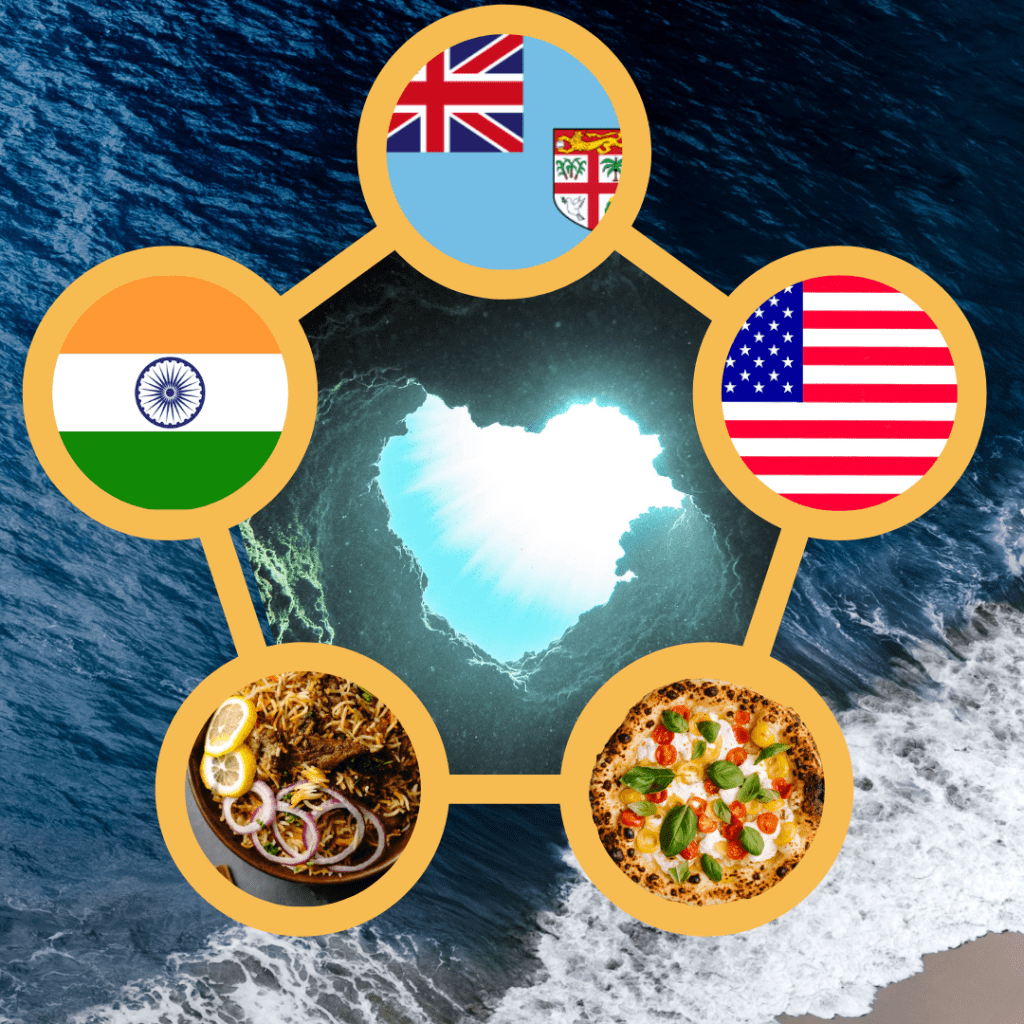
Growing up I always heard the strength of my Paternal Great Great Grandfather’s journey to Fiji. When the British Raj( colonizers) lost the right to have slaves, one of the places they looked to replace the workforce was India. They targeted many youths, including my great-great-grandfather, telling them that they had worked for them just on the horizon. Taking advantage of those who didn’t know much English, the British Raj convinced them to agree to a contract that essentially made them indentured servants. What added salt to the wounds was that they would soon learn that the horizon wasn’t the edge of India or the horizon they could see but rather the islands of Fiji, Trinidad, and the Caribbean. Which is why to this day those places have huge parts of the Desi Diaspora. When these contracts were over you would think that for once my ancestors would have a moment of rest, unfortunately, this wouldn’t be the case. There were 2 options provided to the Indians living in Fiji: 1) they stayed in Fiji and had some land 2) go back to India and start over. My Great Great Grandfather chose the first.
Even after Fiji gained its independence, tension continued to rise. There was a strong disconnect between the Fijian and Indian communities. Due to the coup, my parents immigrated to the United States about 36 years ago. Like my Great-Great-Grandparents, my parents had to leave everything they had ever known in the hopes of a better future for themselves and their families.
I wish I could say this was only the plight that plagues only parts of the Desi Diaspora. However the more I look at my community’s history I realize no matter what part of the Desi diaspora we look at, we can never truly understand the lived experiences without the lens of migration. Whether that is the displacement of Sindhi people when the partition occurred or the struggles faced by Kashmiri refugees due to the Kashmir War. Or relocation of many Indians when the partition of India and Pakistan occurred. I realized that though the diversity in our community makes us a community of many cultures, One thing that truly connects is our stories of migration that ensured the survival of our people.
This need for survival doesn’t come without a price. For so long the previous generations focused on surviving that all they were able to pass down to the next generation. I come from a line of survivors, and I am proud of that. Even with the badge of honor, I hope for the next generation to pass not only the skills to survive but also the ability to enjoy the lives our ancestors fought for us to have.
According to the National Library of Medicine, Mental Health and Stress Among South Asians, I was able to see the data and studies behind these lived experiences. One may argue what does the data matter? To them, I say it’s imperative to include historically marginalized communities, including South Asian as it’s the only way to improve access and quality of care for these communities.
One of the things this study found that resonates with what I have seen in my communities is “ Stress resulting from attempts to incorporate host country traits within one’s own culture, referred to as acculturative stress, can also take a toll on mental health.“ I have seen this in the homefront, within the homes of family, and even when talking to friends, regardless of what POC community they come from. There is this big push to keep traditions alive while fitting into a world where one fails to recognize their belief systems. Furthermore, there is the birth of intergenerational conflicts within the home front. One where many times the elders hold on tightly to the traditions of the past that keep them rooted to their homeland, whereas the next traditions struggle the sense of truly fitting in their home and within the Western world. The elders hold tight to the traditions as it helps them keep what they left behind alive. In the same breath, they had to let go of traditions that they couldn’t keep alive, such as cooking some of their cultural dishes because the ingredients weren’t accessible. Or there wasn’t an elder to teach them. Whereas the next generations struggle to find the balance between the traditions they grew up with and the ones they were exposed to in the Western world. At home, there is a sense of not being enough because of their broken mother’s( parent’s languages) or different understanding of why traditions are done a certain way. My parents’ generation was in survival mode so their relationship with God became God-fearing. If I do XYZ then God will protect me and my family. My generation seems to be more God Loving in the sense that we do these traditions not as a barter but as a way to show gratitude the way a child does when their parents care for them. Intergenerational conflict is normal as culture and religions are always evolving with each generation. However, when they disconnect due to this magnitude the riff can be even bigger.
The biggest way we can address this is if we take the time to understand the history and the plights our elders went through. And more importantly, recognize they may not be able to verbalize to the extent that something affects them on an emotional level. That wasn’t the norm for them nor something they had the time or resources to focus on. With this knowledge, you can show up in a way with more understanding. Not to say that you should become the keeper of their emotions but rather you can show compassion to them while setting the boundaries you need to maintain your peace.
As always embrace your Shakti,
Max

 Embrace Your Shakti
Leave a comment