I feel like every year around this time of year, I enter a stage of grief that feels heavier than most of the year. October is my ostomy surgery anniversary, November marks when I was first diagnosed with Ulcerative Colitis, and December was when I had my first colonoscopy after months of fighting with insurance to get it covered.
Not to say that all of these months are filled with grief. Some of my favorite times of the year also take place during this period—my parents’ birthdays, Navratri, Krishna Janamashtami, Raksha Bandhan, and Christmas. But there are days when the grief definitely hits harder than others.
There is grief around the fact that I got so sick that I could have lost my life at age 17. Grief around the fact that so much of my early adulthood was filled with navigating doctor’s visits. Grief around having a surgery that saved my life but permanently altered it.
And honestly, these particular issues don’t feel as heavy as they once did. But the one that has stuck with me is the religious trauma that was caused by it.
At a young age, I was taught that good things happen when the divine is pleased with our devotion. That a lack of prayer could cause us to become unprotected, thus opening the door for bad things to happen. Furthermore, I was taught that I must have done some great misdeed in a past life to be living with a disability, and that only with “true” faith and commitment to the divine would I be healed. That one day, I wouldn’t need medication to live.
And for a long time, I carried this belief with me. Although I don’t subscribe to this way of thinking anymore, I am still healing from the scars that were left behind.
I knew that, for me, my connection to Sanātana Dharma (Hinduism) was really important. However, I had no idea how to rebuild that connection so that going to the temple or attending poojas didn’t feel bittersweet. I had no idea how to navigate following religious customs while also honoring my body’s needs. Most importantly, I had no idea how to advocate for myself when my elders pressured me to do things that caused my body harm, such as sitting on the floor or eating cultural foods that worsened my symptoms.
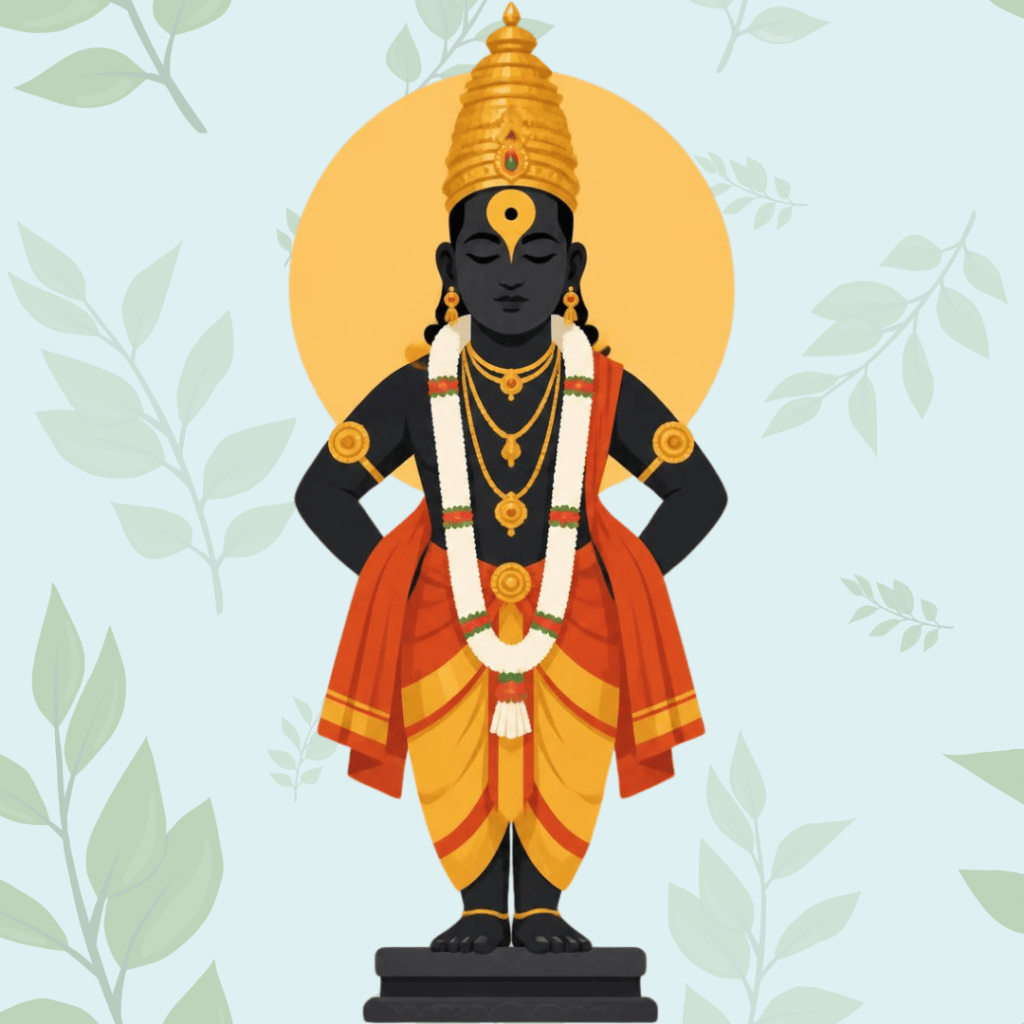
While conducting my research, the story of Kurmadas and Lord Vitthala, a form of Krishna, stuck with me, and I deeply resonate with it to this day.
Kurmadas was a devotee of Lord Vitthala who was born without hands or feet. Despite his disability, he deeply wanted to make the pilgrimage to Pandharpur to see Vitthala. Because he couldn’t walk, he began crawling toward Pandharpur, even though others doubted that he could make the journey. Along the way, Vitthala came to him disguised as a merchant and accompanied him on his journey.
Eventually, Kurmadas realized that he would not be able to reach Pandharpur in time for the festival, so he sent a message with other pilgrims asking Vitthala to come to him instead. Vitthala did come to him, and when He offered Kurmadas a blessing, Kurmadas didn’t ask to be healed or given the ability to walk. Instead, he asked Vitthala to remain there so that other devotees who were unable to make the pilgrimage could also experience His presence.
For me, what makes this story so meaningful is that Kurmadas’s devotion wasn’t dependent on his disability being cured. His relationship with the divine wasn’t conditional on becoming physically able to participate in the same way as everyone else.
Instead, God came to him where he was.
For me, this story has been a beautiful reminder that cure isn’t the only way that prayers are met. Maybe prayer isn’t always answered by removing the thing that makes life difficult. Sometimes the answer is endurance. Sometimes it is another day. Sometimes it is improved health without perfect health. Sometimes it is the people who accompany us.
Sometimes it is discovering that the divine was never waiting for us on the other side of our disability.
Maybe the divine was already beside us.
 Embrace Your Shakti
Leave a comment